
What if we could recover more value from the parts of aquatic food resources that are currently underused?
FOODIMAR, the newest project to join the CIRCULARIS BioCluster, is developing new solutions for transforming side streams from fisheries and aquaculture into sustainable, high-quality food applications.
The three-year project explores how valuable nutrients can be recovered through climate-friendly processing approaches. Its research covers different marine resources, including jellyfish, whitefish, and sea bream, while investigating opportunities to add value to materials generated during seafood production and processing.
By recovering nutrients, diversifying the marine species being explored, and reducing the environmental impact of processing, FOODIMAR aims to contribute to food systems that are more diverse, profitable, and resource-efficient.
As the newest member of the CIRCULARIS BioCluster, FOODIMAR brings additional expertise in aquatic food side-stream valorisation and sustainable food innovation to the collaboration.
New Research Examines the Sustainability of Aquatic Food Side-Stream Valorisation
Turning aquatic food side streams into valuable products can contribute to a more circular blue bioeconomy. However, it is important to understand whether these processes genuinely deliver environmental, economic, and social benefits.
A new review paper from the FOODIMAR team, published in Future Foods in June 2026, addresses this question by analysing 40 peer-reviewed studies on aquatic food side-stream valorisation technologies.
The findings are encouraging: in 80% of the scenarios assessed, valorisation showed lower global warming potential than conventional extraction processes or existing end-of-life options.
At the same time, the review identifies important challenges and knowledge gaps. Most of the technologies assessed are still at relatively early stages of development, while their economic feasibility depends strongly on factors such as production scale, product selling price, and process efficiency.
The social dimension of sustainability remains particularly underexplored. Of the studies reviewed, only one attempted to assess environmental, economic, and social sustainability together.
The authors therefore call for more harmonised reporting and comprehensive sustainability frameworks that make it easier to compare technologies and understand their real impacts across all three dimensions of sustainability.
Read the full FOODIMAR publication: https://doi.org/10.1016/j.fufo.2026.101084
Seafood Is More Than a Fillet
How much of a fish actually becomes the fillet we see on our plate?
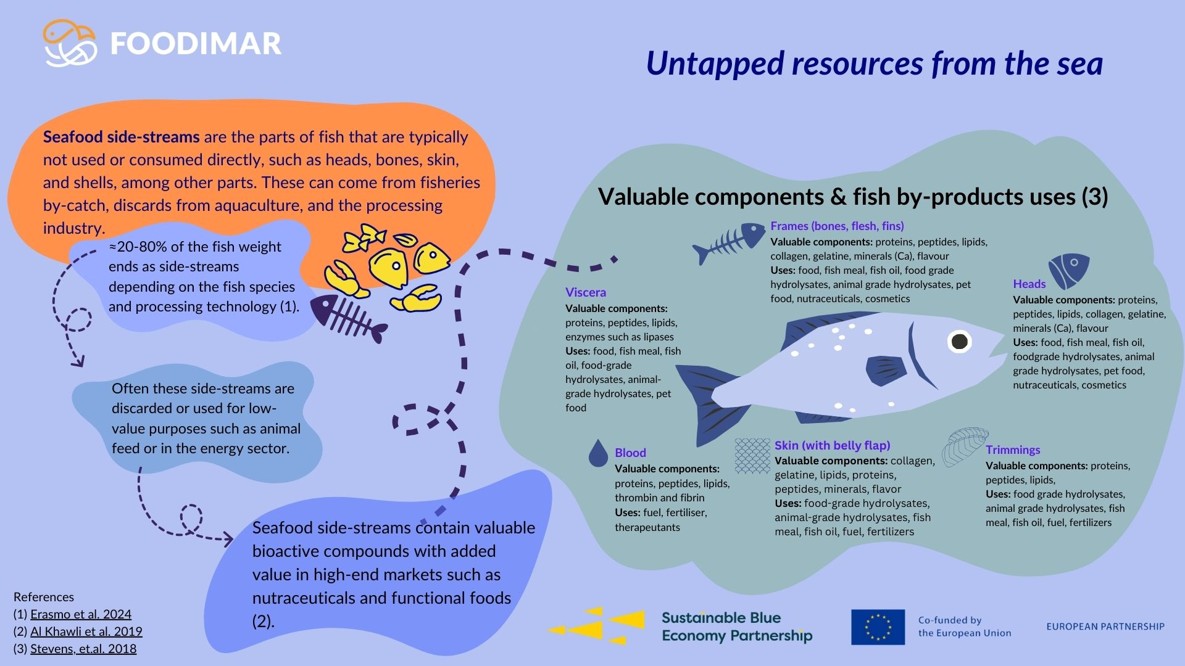
Depending on the species and processing technology, approximately 20–80% of a fish’s weight can become side streams. These include heads, bones, skin, viscera, blood, frames, and trimmings.
FOODIMAR’s Seafood Side-Stream Awareness Campaign draws attention to the valuable resources contained in these materials. Its infographic, Untapped Resources from the Sea, shows that different parts of fish can contain proteins, peptides, lipids, collagen, gelatine, minerals, and enzymes.
These components can potentially find applications in a wide range of products, from food and animal feed to nutraceuticals, cosmetics, fertilisers, and other uses.
By presenting this information in an accessible visual format, FOODIMAR encourages a different way of looking at seafood production: materials that may appear to be leftovers can contain valuable resources waiting to be better used.
Explore the FOODIMAR infographic and discover the valuable compounds found in seafood side streams:
Strengthening the CIRCULARIS BioCluster
FOODIMAR joins ONE EARTH, VALORISH, PROMISEANG, and MARMADE in a growing collaboration focused on sustainable and circular use of biological resources.
Its expertise in aquatic food side streams, nutrient recovery, sustainable processing, and food applications complements the different approaches explored across the CIRCULARIS BioCluster.
Together, the five projects are sharing knowledge, communicating their research to wider audiences, and exploring opportunities for stronger scientific and technical collaboration across the European circular bioeconomy.